Compilers & Language Engineering
Blang (Bitis)
Lazy functional language with compile-time ownership and borrowing instead of garbage collection
Overview
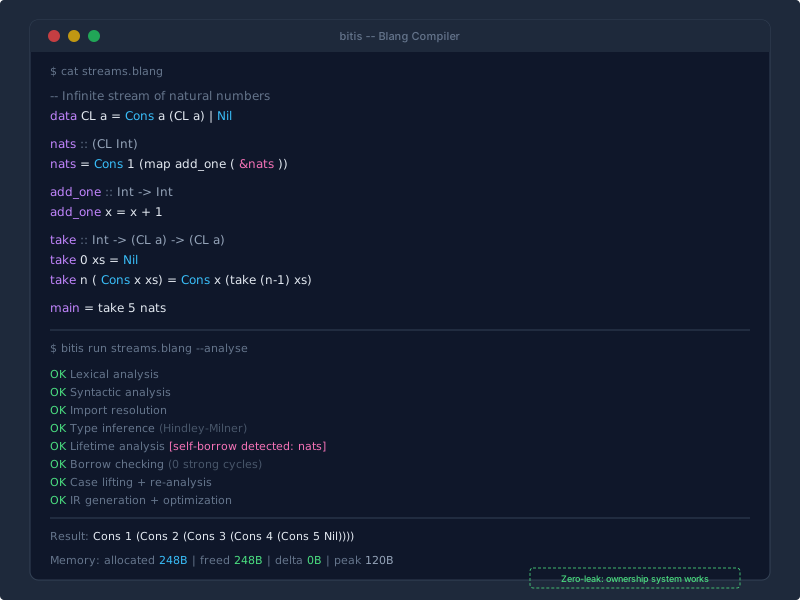
Blang is a complete compiler and interpreter for a lazy functional programming language that replaces garbage collection with compile-time ownership and borrowing analysis -- the first language to combine Haskell-style lazy evaluation with Rust-style memory management. The compiler implements a full pipeline from source to interpreted execution: lexing, parsing, Hindley-Milner type inference with polymorphism, lifetime analysis, borrow checking with cycle detection, case lifting, three-pass optimization, and a stack-based virtual machine interpreter with runtime memory tracking. Published as MSc thesis at the University of Ljubljana.
Architecture
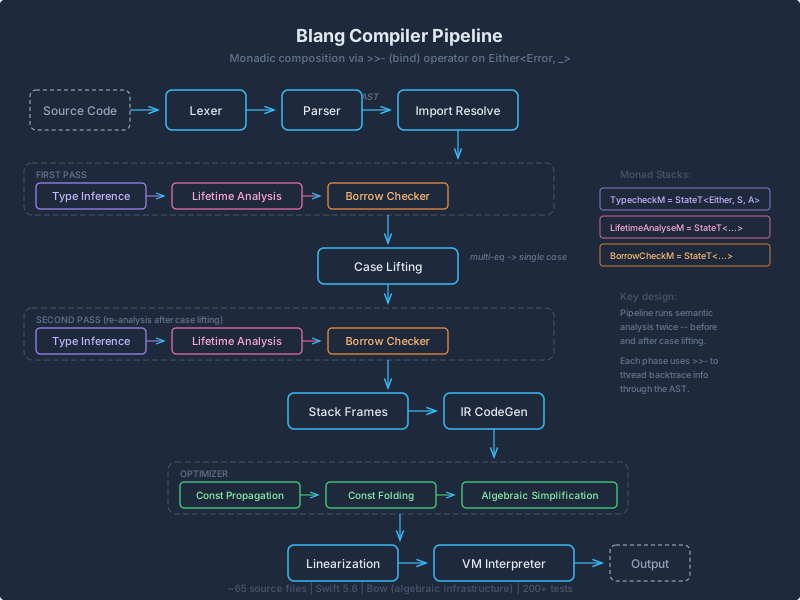
The pipeline is composed via a custom >>- (bind) operator on Either<Error, _>, forming a monadic chain where each phase transforms the AST and can short-circuit on error. Semantic analysis phases run twice -- once before case lifting and once after -- because case lifting transforms multi-equation function definitions into single-case expressions, changing the AST shape. Each major phase has its own monad stack (StateT<Either<Error>, PhaseState, _>) with automatic backtrace threading at every AST node visit.
Key concepts
Self-Borrows
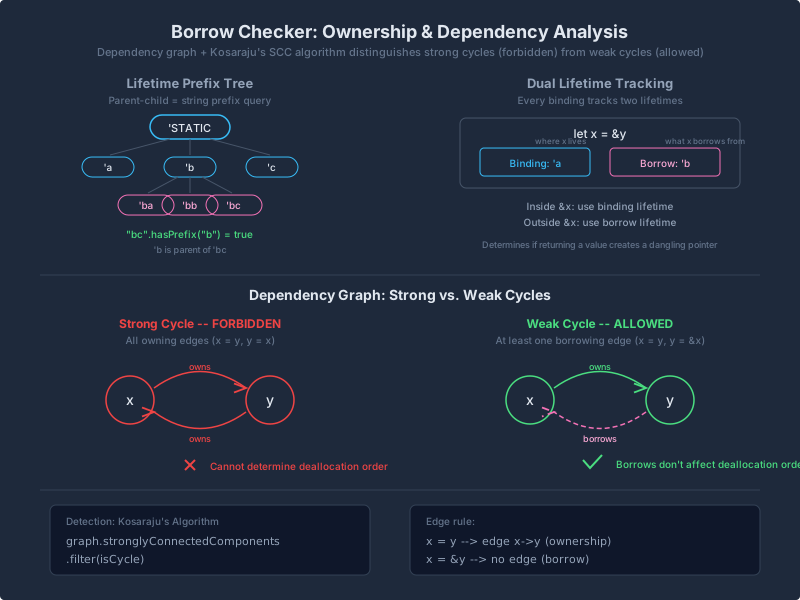
The central novelty of the thesis. In a lazy language, a value can contain a reference to itself because the thunk hasn't evaluated yet -- enabling cyclic structures (graphs, infinite streams) without violating ownership rules. The compiler detects self-borrows by comparing the borrow lifetime with the binding lifetime.
Lifetime Prefix Trees
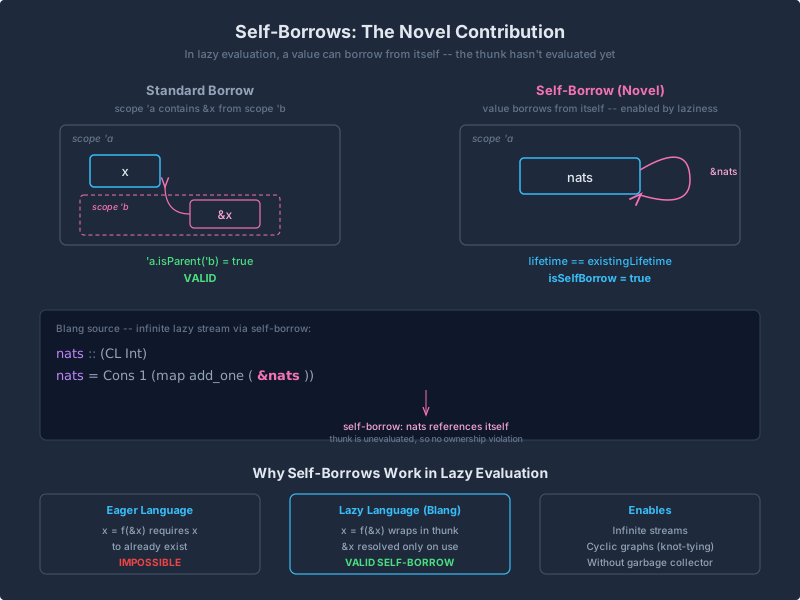
Lifetimes are modeled as hierarchical string identifiers where parent-child relationships are prefix queries on strings. Lifetime 'aa is parent of 'aab because "aab".hasPrefix("aa"). This turns tree operations into O(n) string operations -- entering a scope appends a character, exiting pops it.
Code highlights
let isSelfBorrow = lifetime == existingLifetime?.lifetime
let isValid = lifetime.isParent(of: currentLifetime) || isSelfBorrow

guard isValid else {
  return .error(.cannotReferenceLocalValue)
}

// If it's a self-borrow, remove the lifetime annotation from the body
// to prevent the borrow checker from treating it as an escaping reference
let body = isSelfBorrow ? body.withLifetime(nil) : bodyextension LifetimeIdentifier: ParentChildRelation {
public func isParent(of other: LifetimeIdentifier) -> Bool {
self != other && other.identifier.hasPrefix(self.identifier)
}
public func isChild(of other: LifetimeIdentifier) -> Bool {
self != other && self.identifier.hasPrefix(other.identifier)
}
public func commonParent(_ other: LifetimeIdentifier) -> LifetimeIdentifier? {
let prefix = self.identifier.commonPrefix(with: other.identifier)
if prefix.isEmpty { return nil }
return .init(identifier: prefix)
}
}public func >>-<A: HasPosition, B>(
_ m: StateT<EitherPartial<BCError>, BCState, A>,
_ f: @escaping (A) -> StateT<EitherPartial<BCError>, BCState, B>
) -> StateT<EitherPartial<BCError>, BCState, B> {
m
.flatMap(BorrowCheckM<A>.backtrace) // automatic backtrace
.flatMap(f)^
}Highlights
- — Novel PL contribution: first lazy functional language using ownership/borrowing instead of GC, introducing self-borrows for cyclic data structures (graphs, infinite streams)
- — Full-stack compiler pipeline in Swift (~65 source files): lexer, parser, Hindley-Milner type inference, lifetime analysis, borrow checking, case lifting, IR generation, three-pass optimizer, and stack-based VM
- — Lifetime prefix trees: hierarchical lifetimes as strings where parent-child queries reduce to string prefix operations
- — 200+ test cases for memory analysis phases organized by error category, with a 700-line formal ownership manifesto
- — Research-grade monadic architecture: three independent monadic phases (TypecheckM, LifetimeAnalyseM, BorrowCheckM) with Haskell-style operators
Related projects
Atheris
Complete compiler for a Swift-like OOP language with vtables and polymorphic dispatch
View →SML-to-Racket
Source-to-source compiler with lambda calculus IR and Church-encoded algebraic datatypes
View →PINS Compiler Course
8 progressive compiler assignments from lexer to interpreter for 100+ university students
View →