Compilers & Language Engineering
clox
Single-pass bytecode compiler and stack-based VM in pure C with Pratt parsing
Overview
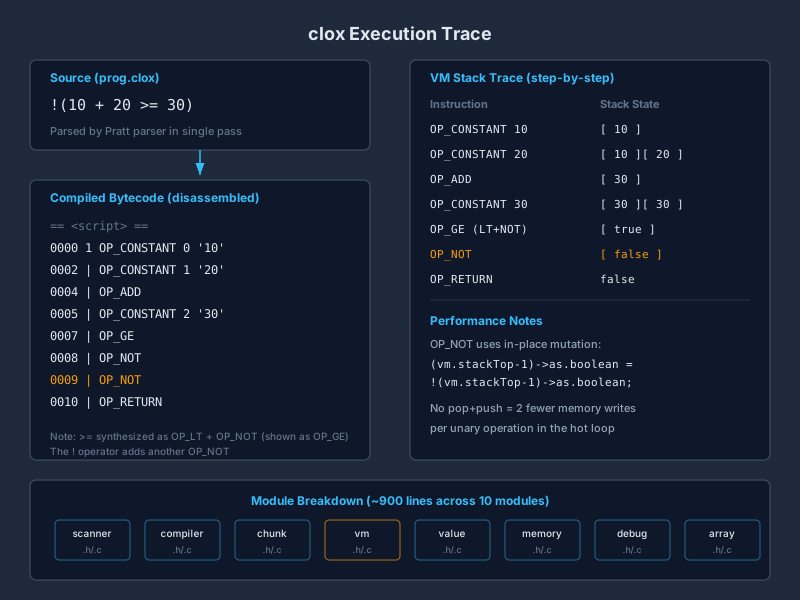
clox is a bytecode compiler and stack-based virtual machine for the Lox programming language, implemented in pure C. The system compiles source text in a single pass directly to a compact bytecode representation using a Pratt parser for operator precedence, then executes the bytecode on a register-free stack machine with a tagged-union value representation. The implementation covers trie-based keyword scanning, run-length encoded line information, constant pool with automatic promotion from 8-bit to 24-bit operands, and ~900 lines across 10 modules.
Architecture
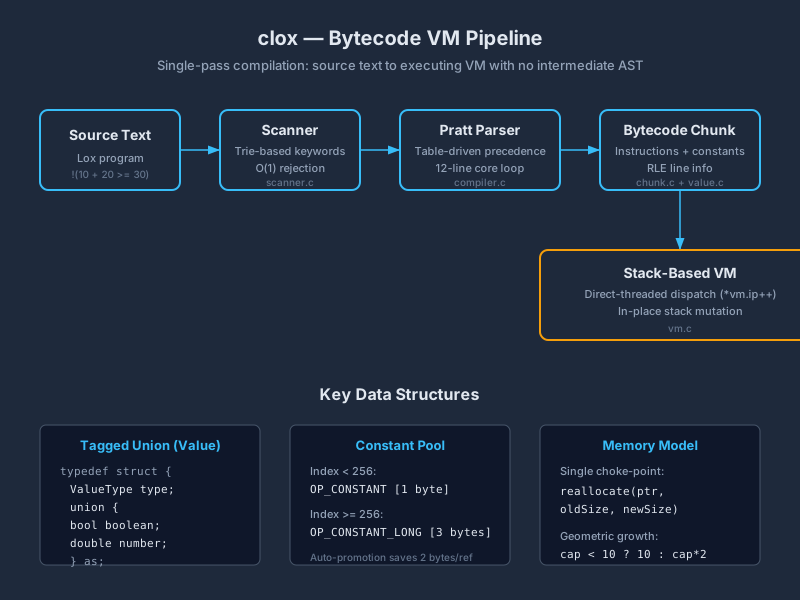
The compiler emits bytecode directly during parsing with no AST intermediate, enabled by the Pratt parser which handles operator precedence through a table lookup rather than grammar encoding. A static VM instance avoids pointer indirection on every stack operation. A single Chunk struct owns the instruction stream, constant pool, and source position data, keeping related data co-located.
Key concepts
Pratt Parser (Top-Down Operator Precedence)
A table-driven parser where each token type maps to a ParseRule struct with prefix function, infix function, and precedence level. The parsePrecedence() function drives the entire expression parser in 10 lines -- advance, call prefix rule, then loop calling infix rules while precedence is high enough.
Code highlights
static void parsePrecedence(Precedence precedence) {
    advance();
    ParseFn prefixRule = getRule(parser.previous.type)->prefix;
    if (prefixRule == NULL) {
        error("Expected expression.");
        return;
    }
    prefixRule();
    while (precedence <= getRule(parser.current.type)->precedence) {
        advance();
        ParseFn infixRule = getRule(parser.previous.type)->infix;
        infixRule();
    }
}
Highlights
- — Complete single-pass bytecode compiler in C -- from source text to executing VM -- with no AST intermediate representation
- — Pratt parser: the entire expression language parsed by a 12-line function plus a data table
- — In-place stack mutation, RLE-compressed debug info, automatic constant-operand size promotion, and unified allocation choke-point for future GC
- — Low-level C craftsmanship: manual tagged unions, macro-based generic containers, geometric growth allocators
Related projects
Blang (Bitis)
Lazy functional language with compile-time ownership and borrowing instead of garbage collection
View →Atheris
Complete compiler for a Swift-like OOP language with vtables and polymorphic dispatch
View →SML-to-Racket
Source-to-source compiler with lambda calculus IR and Church-encoded algebraic datatypes
View →