Engineering · Nov 2, 2026
Scaling AI Video Production
with Predictable Results
By Toni · 13 min read · 7 chapters
Inside Everyframe: how an AI agent turns a creative brief into video variations and how the rendering engine keeps the output consistent and verifiable.
One campaign idea rarely means one video. Four opening hooks, three languages and four screen formats already add up to 48 versions.
Everyframe uses an AI agent to help create those variations. Behind it is a video rendering engine built to follow a precise plan and produce repeatable results. That's what we mean by deterministic video rendering: the same instructions produce the same output.
Before production starts, every plan the agent creates gets a unique digital fingerprint. Once a video is finished, it can be checked against that plan, even offline, without rendering it again. The engine's motion renderer has also produced identical frames from the same plan on every machine we've tested.
For example: inside marketing teams, this means AI-assisted video production with a clear record of what was planned and a way to verify the finished result.
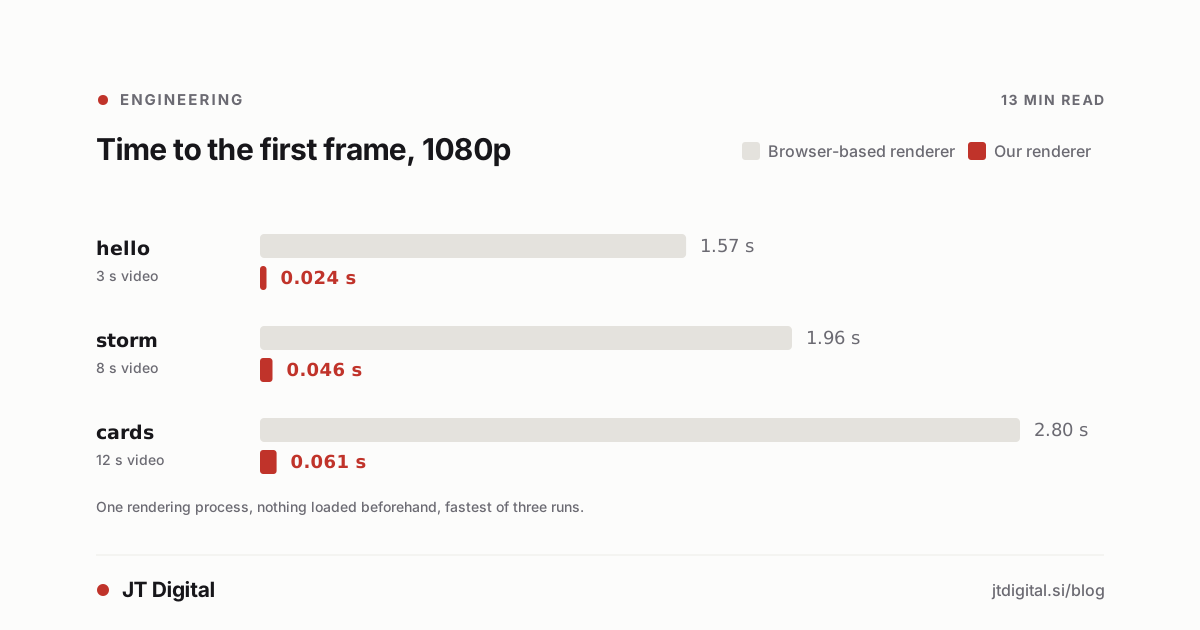
This post walks through how it works: the AI agent, how the system interprets visuals, how it creates motion, how it produces videos at scale, and how it verifies the output. We'll also cover rendering speed and where the engine runs.
Every clip in this post was made with the engine itself. We reused the instructions behind Everyframe's demo clips, applying this blog's colours and typography. The footage was generated specifically for those demos, featuring Brumo, a fictional speaker brand we created.
Chapter 1 of 7
How an AI agent edits video
Why is AI-generated video hard to trust?
A generative video model paints every pixel itself. Text inside its frames often comes out garbled, and a logo or a product may not match the real one. The model also cannot say which steps produced a given frame, so nobody can audit the result.
The law now asks for that trail. Since 2 August 2026, Article 50 of the EU AI Act requires providers of AI systems that generate or edit video to mark the result in a form software can detect. Footage of people is also personal data under the GDPR, so a customer needs to know who processed it, how, and where.
What does an AI video agent do?
An AI video agent turns a brief and the customer's own footage into a finished edit. Everyframe's agent reads both, asks every open question on one card, then shows the plan shot by shot, with its cost.
Titles, prices and logos are drawn in code from the customer's own text and files, so they come out exactly as typed. A generative model only fills a shot that is missing, and only after the customer approves it. When the pieces are made, a second agent looks at each one and sends back any that fail, with the reason.
The agent asks before it plans, a missing shot is made from words after a yes, and a second agent checks every piece.
Next · Chapter 2 of 7
Computer vision in the plan
3 min read →
More in this vein
Our Claude Code Workflow: How We Ship Software
Our Claude Code workflow rests on plans kept in git, rules the agent reads first, a typed stack that rejects mistakes and in-house tools that feed each other.
14 min read · Toni
Type-Safe HTML in TypeScript: Wrong Markup Won't Compile
Type-safe HTML in TypeScript turns a misspelled route, a wrong HTMX target or an impossible view state into a compile error. This is how fluent-html does it.
10 min read · Toni
Olimpijski Kviz: a live TV quiz without WebSockets
Olimpijski Kviz, a live TV quiz on RTV Slovenija, ran 16 Olympic broadcasts with zero critical errors. Built for 10,000 concurrent players, with no WebSockets.
14 min read · Toni
Stay in the loop
Don't miss the next one.
One email when we publish something worth your time.